
El Rincón de Ademúz
This is the most unusual region, a Valencian island in land belonging to Aragón and Castilla-La Mancha. Its high altitude gives it a cold climate in winter and a very pleasant one in summer, which makes the Rincón a very popular hiking destination. The architecture of these towns, such as Ademuz or La Puebla de San Miguel, is notable for its wooden balconies, old water mills, shrines and fortified churches. The Roman Shrine of the Virgen de la Huerta, and the Church of Saint Peter and Saint Paul in Ademuz, the Fortress Church of Our Lady of the Angels in Castielfabib, and the Ethnological Museum at the Puebla de San Miguel, are especially noteworthy.
Municipalities
-
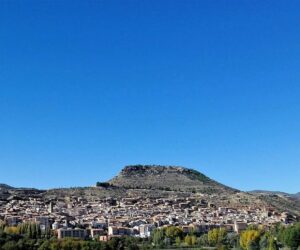
Ademuz
The municipality of Ademuz also contains the hamlets of Sesga, Mas del Olmo and Val de la Sabina, all of them inhabited with stable populations. The terrain is uneven and mountainous. Its economy has traditionally been based on agriculture, and especially the cultivation of almonds and apple. The main language is Spanish, due to the repopulation (mainly Aragonese) that took place in the 13th century.
-
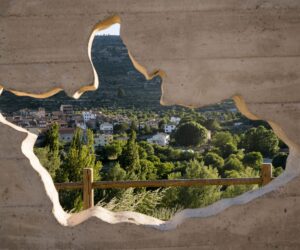
Casas Altas
Situated between the municipalities of Casas Bajas and Ademuz on the N-330, some 2 km from the first and 4 km from the second. Casas Altas is a municipality located in the southern sector of Rincón de Ademuz. Its boundaries are: to the north and east, Ademuz; to the west, Vallanca and Ademuz; to the south, Casas Bajas and Santa Cruz de Moya (Cuenca).
-
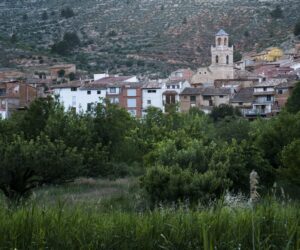
Casas Bajas
It is located in the south of the Rincón de Ademuz administrative region. The municipality is mountainous and uneven. The main peaks are: “La Somera” (981 m.), “Peña Alta” (1057 m.) and “La Molatilla” (1045 m.), a third-level geodesic point. The River Turia crosses the municipality from north to south, circulating for a good stretch through a fertile plain before entering a deep gorge. The “Malas Noches” and “Rambla del Barranco” ravines flow into the river. The climate is continental. As in the neighbouring Casas Altas, the prevailing winds blow from the north, east and southwest, with the latter bringing rains in the autumn and the spring. Winters are cold.
-
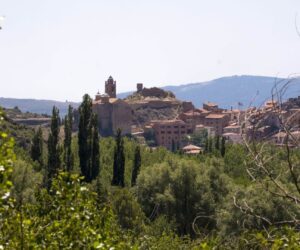
Castielfabib
Affectionately called “little Albarracín”, this small, craggy municipality lies on a hill on the right bank of the River Ebrón. Located in the northwest corner of Rincón de Ademuz, the municipality is mountainous, with altitudes of between 800 and 1,550 m.
-
La Puebla de San Miguel
The entire municipality of La Puebla de San Miguel is considered of extremely high archaeological value. Mention may be made of the largest number of monumental junipers in the Valencia Region, and perhaps in Spain which, dated by technicians, may be between 1,500 and 2,000 years old: authentic living fossils.
-
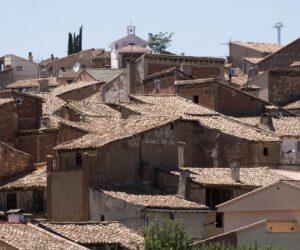
Torrebaja
Its terrain is relatively hilly, as it lies in the Turia valley. It is surrounded by high mountains, especially to the east, where we find the foothills of the Sierra de Javalambre and Sierra de Tortajada ranges. The rivers Túria and Ebrón rivers run through the municipality.
-

Vallanca
Vallanca is a municipality pertaining to the administrative region of Rincón de Ademuz. It is located in the west of the region. The municipality borders to the north with Castielfabib and Salvacañete, to the east with Ademuz, to the south with Casas Bajas, and to the southwest with several municipalities in the province of Cuenca (Moya, Garcimolina and Algarra). The municipality covers an area of 56.49 km2 and is rugged. Its main geographical feature is the valley of the River Vallanca, or Bohigues, which crosses the municipality from west to east and flows into the River Turia in the village of Ademuz. Agriculture and livestock farming are the village’s main activities. The agricultural land is dedicated to dryland farming (cereal and vines), with a small area of orchards near the River Vallanca. Livestock farming is centred on sheep-rearing and beekeeping. Vallanca currently has some 180 inhabitants. Within the municipality is the hamlet of Negrón, now almost deserted.


