
Requena - Utiel
This region includes the great wine reserve of the Province. It is the westernmost region of the Province. Its rich landscape is remarkable, since the flat area of Requena is joined by the magnificent landscapes of Los Cuchillos and Hoces del Cabriel, and the lush forests of Sinarcas. The two large towns around which the economy of the region turns are Requena and Utiel. Requena is known for the Old Town, of which a tour should certainly be taken, full of monuments and buildings of great historical value, such as the Churches of El Salvador and Santa María, the Keep, a sample of its splendid past, not forgetting its famous Town Cave. In Utiel, the Church of the Assumption, the Bullring, the Shrine of the Nuestra Señora de los Remedios and the Round Winery (headquarters of the Wine Museum), all stand out. Also noteworthy are the Iberian site of Kelin, in Caudete de las Fuentes, and the Roman bridge of Venta del Moro. In this municipality there is also a great deal of active tourism around the Cabriel river.
Municipalities
-
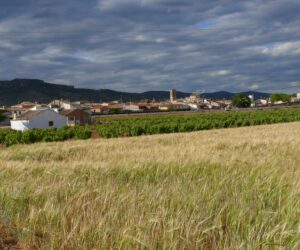
Camporrobles
Camporrobles is situated at an altitude of 900 meters above sea level, bordering the province of Cuenca. The village offers numerous possibilities for enjoying history and nature in an educational manner, from hiking along the Iberian route to climbing up to an Iberian settlement. Places of interest within the village include the neoclassical church of Our Lady of the Assumption and the Ethnographic Museum. There are numerous sites of great natural beauty in the surrounding area: “El Molón” spring, “San Cristóbal” hill and “El Castillete”, located at the Contreras Reservoir. There are two local sports: “el tiro del barrón” and “el tranco”.
-
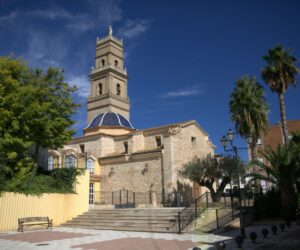
Caudete de las Fuentes
If anything characterizes Caudete de las Fuentes, it is its long history. This is due to its location on natural routes of communication between the plateau and the Mediterranean (“The Royal Cattle Road between Madrid and Valencia, also known as Las Cabrillas road”, in the words of Madoz), and the south and north of the peninsula (Castulone – Valentia by Egelesta. Possible “Ancient Way” of Strabo III,4,9. Rep 152. ). The area has been heavily-populated since the Bronze Age. There are remains of the site dating from this period at “Casa Doñana” and “Los Villares”, both of which were notable Iberian settlements that survived until the shortly before the change of era and which have offered highly interesting finds. A large amount of coins was found in “Los Villares”, their presence owing to the fact that the Iberian city had its own mint (it issued “asses” and “semis”). In fact, it is one of the few places where it is possible to reliably follow the stratigraphic sequence of the archaeological sites from the Bronze Age (when the site experienced its greatest splendour with the installation of the Iberian City of KELIN, capital of Los Olcades) through to the subsequent Roman and Muslim periods and up until the present time.
-
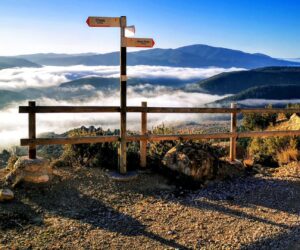
Chera
Chera is a mountainous municipality in the province of Valencia. It has 611 inhabitants and lies 85 km from the capital. Immersed in an enveloping tranquility and quiet, the village is located inside an enormous graben formed sixty-five million years ago and is surrounded by steep peaks of up to 1,176 m. Its economy is based mainly on rural tourism and mountain farming, which includes the cultivation of almond and olive trees. Measures have been taken to preserve and protect the village’s unique natural and scenic values through the creation of the only Geopark in the Valencia Region, together with an Environmental Foundation and a Natural Park. It includes areas of striking beauty and great interest for tourists, including the Buseo Reservoir, “La Hoz Ravine, the “Garita” caves and Chera Castle, among others.
-
Fuenterrobles
–
-
Requena
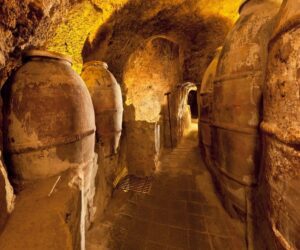
Requena has a rich history, which stems from its strategic location and the domination that it has exerted since ancient times over the natural route linking Valencia with the Castilian plateau, passing through the “Cabrillas” mountain range and “Contreras” Pass. Its old town reflects the splendour of those times in which, curiously, the municipality did not depend on the wine industry, but rather its economic activity was focused on the production of silk, as evidenced by the Silk College located in the heart of the La Villa neighbourhood. Requena offers a unique opportunity to visit a medieval city – from underneath. Visitors can enjoy a tour through the ancient caves in which wine, olive oil and cereals were formerly stored in large vats.
-
Sinarcas
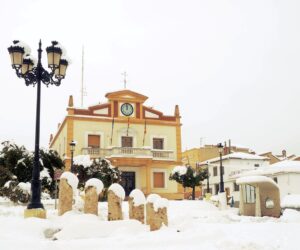
An important enclave in former times (as evidenced by the archaeological findings in the municipality, especially that of a tombstone bearing Iberian inscriptions). St. James Church (19th century), which houses a statue of “Our Lady of the Bells”. The Hermitage of Saint Mark (located in beautiful natural surroundings). The Hermitage of Saint Roche and the Hermitage of Saint Catherine. Traditional Rural Habitat Ecomuseum. Natural sites: “Charco Negro” (with medicinal waters), “Palomarejas”, “La Peña de las Grajas”, “Las Hoyuelas” and “La Toba”. Valdeserrillas National Reserve, with Iberian fauna: mouflon, boar, genet and others. Artisan leaded or coppered stained glass, as well as the manufacture of clothing typical of the region.
-
Utiel
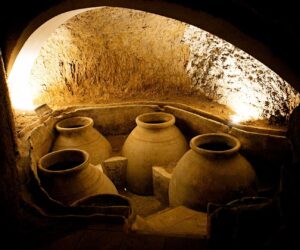
Located at the foot of the Sierra del Negrete range, Utiel has Iberian and Roman origins and displays a clearly Arabic influence in its urban layout, where the visitor can admire houses and other typical architectural elements dating from the Christian medieval period. There is a network of underground galleries running throughout the town. They have been destined to use as shelters and storage space. At 10 k from the town lies the Sanctuary of Our Lady of the Remedy, built in 1564 and originally a hermitage. The Sanctuary offers many attractions for visitors, and especially the main building, which houses the chapel, the chapel of the Virgin, the crypt of Juan de Arges and the museum of votive offerings. Furthermore, in its surroundings the visitor can visit the location in which, according to some legends, the Virgin Mary made an appearance, cool off in “Casa del Peregrino”, or sit and relax and contemplate the beautiful natural landscape in which the sanctuary is located.
-
Venta del Moro
–
-
Villargordo del Cabriel
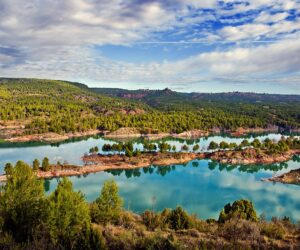
Villargordo del Cabriel is located in the westernmost part of the Valencia Region, in a landscape dominated by the River Cabriel , whose depression forms a natural border with Castile La Mancha. The enviable natural environment in which it is located is the result of the action of the River Cabriel and its slopes, one of the cleanest rivers in Europe and the originator of valleys, gorges, ravines, etc. Difficult access due to the rough terrain has enabled the excellent state of preservation of the natural environment and the species that inhabit it. A visit to the Los Cuchillos and Las Hoces del Cabriel is a must. These border lands have been marked by Iberians, Romans and Arabs, and have been witness to bloody battles to dominate a territory considered a strategic enclave. In the midst of this harsh environment there is an abundance of greenery in the form ofMediterranean forests populated with pines, holms oaks and cluster pines, as well as other native shrubs. The fauna is representative of wooded areas, with the presence of birds of prey and freshwater aquatic animals, as well as other species associated with forests (squirrels, etc.). The Mediterranean climate, with continental influences, offers a predominance of sunny dayssuitable for hiking and enjoying the surroundings.


